


Over the last few years, artificial intelligence, commonly known as AI, has greatly improved and taken the world by storm in both formal and informal settings. With this boom in usage, companies that run these AI platforms have needed to build new campuses and expand their already-existing AI data centers around the world to accommodate the new amount of power needed to handle the increasing income of prompts from consumers.
Seven cities in the state of Wisconsin, which is already home to 44 AI data centers, have been given proposals from unidentified companies for new centers and campuses that will be built on thousands of acres of farmland. For the surrounding communities, taxes will be raised to fulfill the amount needed to build the center, which combined is millions of dollars.
An example of this is currently happening in the city of Port Washington, located in southeast Wisconsin, which recently approved the construction of a new 8-billion-dollar AI data center, to be named Lighthouse, that will be built on 672 acres of farmland. To obtain the amount of funds needed to support the construction, the city is currently considering a tax incremental financing worth 458 million.
Not only will this decision affect the county’s residents financially, but the AI data center will also impose many negative effects on the surrounding environment. According to Ozaukee Press, the AI data center “calls for [Port Washington] to provide as much as 1.2 million gallons of water per day” to cool the systems that will be running within the buildings. The company also refuses to state what they will be doing to help clean and keep the water safe for future use.
Port Washington’s AI data center is going to be built in phases, starting with only one or two operating buildings while the others are under construction. During this initial phase, the center is projected to need 1.3 gigawatts of electricity to operate. This is the equivalent of turning on 130 million LED light bulbs at the same time. As the plant grows, the electrical usage will increase, potentially reaching up to 3.5 gigawatts of power. This means that Lighthouse will be the largest energy consumer in Wisconsin.
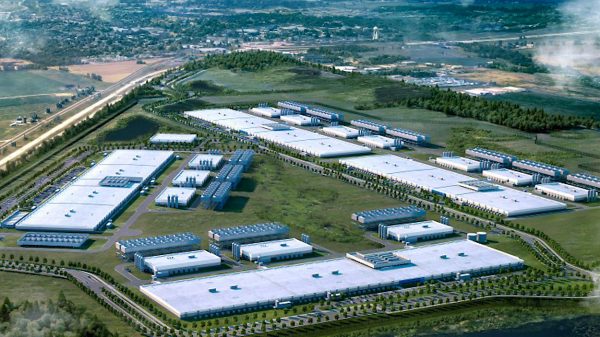
Photo Courtesy of the City of Port Washington.
To put that amount of energy into perspective, the average American home uses around 11,000 kilowatts of electricity annually. One gigawatt of energy has the ability to power 812,000 homes for an entire year. When calculated, that means the AI data center in Port Washington, if it ends up using around 3.5 gigawatts of electricity like it is expected to, would be using the amount of energy needed to power around three million American homes.
By compressing all this electricity into one location, it is very likely that the AI data center will produce enough air and water pollutants to increase the likelihood of cancer appearance in surrounding residential areas that are exposed for long periods of time. While that is not directly caused by the technology housed within the center, it is caused by the usage of environmental aspects like air and water that are used to cool the systems within.
Many residents that live in cities who have been proposed or affected by AI data center constructions have been protesting. Port Washington is one of several Wisconsin cities that have been affected by construction proposals; some have already accepted, but many remain undecided. The cities that have accepted these proposals include Mount Pleasant, Beaver Dam, Wisconsin Rapids and Kenosha. All these cities are giving up thousands of acres of farmland and are sacrificing their water and air quality for the development of AI.
Residents will be impacted by these constructions, and so they have begun Facebook groups and held town meetings in an attempt to stop the construction or to become further educated on the topic. In a world that is becoming overridden with artificial intelligence, it is important to be informed and aware of both the positives and negatives to be prepared for what comes next.
To learn more about the AI data centers in Wisconsin, many Wisconsin-based news sites have written articles about them, and there is a lot of good general information on Google or other search engines. To be more connected to local communities, look on Facebook for groups that are discussing the centers and how they are affecting the surrounding areas.
References
Harvard Business Review (2025)
Milwaukee Journal Sentinel (2025)
Ozaukee Press (2025)
WISN (2025)
Wisconsin Public Radio (2025)
Je • Dec 13, 2025 at 8:27 pm
Make it stop. No one in Wisconsin actually wants it
Samantha Doucas • Dec 10, 2025 at 9:02 am
Hi Samantha,
Great Article! Really sums up what the state is facing with AI Data centers and how they’ll affect our communities. If you’re interested there will be a little presentation about AI data centers in Sheboygan this weekend. This will be at 9:30 AM on Saturday December 13th at Mead Public Library at the Rocca Room. Let me know if you can make it!